Dip Bar for Calisthenics: Types, Height, Brands & Training
Guide to dip bars and parallel bars: standalone vs adjustable, best brands, how to choose. For dips, L-sit, and HSPU training.
What is a dip bar?
Dip bars (also called parallel bars or dip stands) are two parallel rails raised off the floor, designed primarily for dips and pressing movements. Unlike parallettes, which sit low to the ground (4 to 30 cm), dip bars are tall enough for full dips with legs hanging freely - typically 60 to 90 cm high. The extra height is the key difference.
Dip bar exercises
Dips are the primary use. The range of motion on standalone dip bars is typically better than on the integrated dip handles found on pull-up stations, because the width is adjustable on many models and you aren’t constrained by a fixed frame. Full-range dips, where the upper arm reaches parallel to the floor at the bottom, are more effective than partial reps and require enough depth to be possible.
L-sit progressions work well on dip bars. The height allows you to train the L-sit with hip flexor strength as the limiting factor, rather than wrist strength or ground clearance. Many people start L-sit training on parallettes and move to dip bars as compression strength improves.
Korean dips (a behind-the-body pressing movement that targets shoulder extension) are easier to set up on dedicated dip bars than on integrated stations. The parallel position and height give full shoulder extension range without obstruction.
Handstand push-up progressions also work. Some athletes use taller dip bars as a high-parallette variation for pike push-ups, deficit pressing, and HSPU negatives.
Straight-bar dips require a single horizontal bar at chest height rather than parallel bars. A sturdy pull-up bar at the right height handles that variation - standard parallel dip bars don’t apply.
Types of dip bars
| Standalone dip bars | Adjustable dip station | Pull-up rack with dips | |
|---|---|---|---|
| Footprint | Medium | Medium | Large |
| Adjustability | Fixed height and width | Height and sometimes width | Fixed dip handles |
| Portability | Moderate | Low | Not portable |
| Price | Medium | Medium to high | High |
| Best for | Dips and L-sit, compact space | Multiple users or heights | Full home gym setup |
How to choose
For dips and L-sit as the main use cases, standalone dip bars are the simplest and most space-efficient option. They take less room than a full power tower and are cheaper than adjustable stations.
Adjustable height matters if you share equipment with people of significantly different heights, or if you plan to use the bars for HSPU work at varying deficit depths. Most people at a fixed training height don’t need it.
Width adjustability is uncommon but worth looking for if you have specific shoulder width requirements. Standard fixed-width bars are typically 55 to 65 cm apart, which fits most people for regular dips.
If you already have a pull-up bar or power tower with integrated dip handles, those may be enough unless range of motion or width is a problem. The trade-off is usually less depth and fixed bar spacing.
Which brands make dip bars
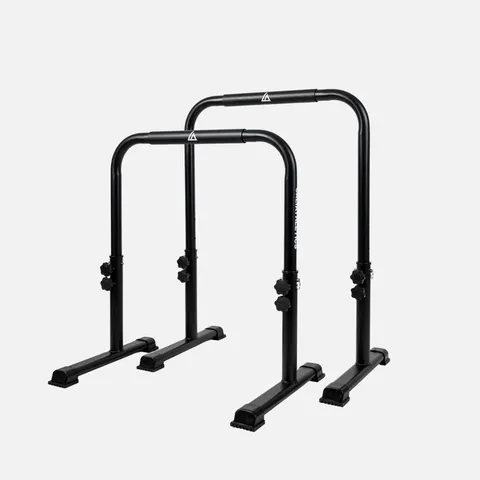
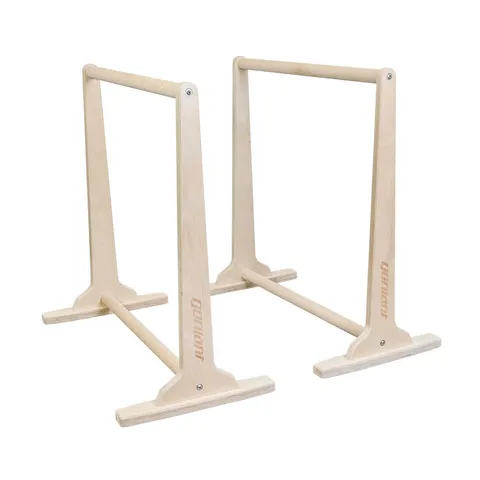
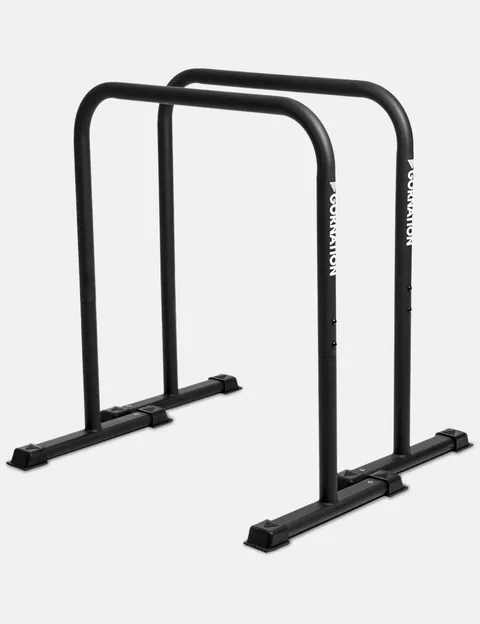
Gornation, Gorletic and Caliathletics all sell dip stations into the European market, in steel and in wood, fixed and adjustable.
Technique
Grip the bars with hands neutral (thumbs pointing forward). At the bottom of a dip, keep elbows tracking back and slightly flared - not pointing straight out to the sides. Leaning slightly forward shifts emphasis to the chest; staying upright targets the triceps more.
For L-sit, press firmly into the bars to lift the hips, then engage the hip flexors to raise the legs. Most people start with a bent-knee tuck before attempting a full L-sit with legs extended.
The most common dip error is partial range - stopping before the upper arm reaches parallel. Full-range dips take longer to build strength for but produce more consistent results over time.
FAQ
Dip bars vs parallettes?
Height is the main difference. Parallettes sit close to the floor (4 to 30 cm) and are best for planche, L-sit, and push-up work. Dip bars are tall enough for full dips with legs hanging free. If you train both skills, you want both pieces of equipment.
How wide should dip bars be?
Shoulder-width is the standard, typically 55 to 65 cm. Wider bars allow more range of motion at the shoulder but increase joint stress. Start at shoulder-width and adjust if needed.
Can I use dip bars for pull-ups?
No. Dip bars are parallel and sit at chest height, not overhead. For pull-ups and hanging work, you need a bar at full-arm overhead height.
Dip bars vs power tower?
Power towers combine pull-up, dip, and sometimes row in one unit but take significantly more floor space and cost more. Standalone dip bars are simpler and cheaper if dips and L-sits are the main goals and you already have a pull-up bar elsewhere.
What height should dip bars be?
Tall enough to hang your legs freely at the bottom of a dip without touching the floor. For most people, 70 to 80 cm bar height works. If you’re taller, look for stations with height adjustment.
Are dip bars good for beginners?
Yes, with one condition: the height must let you do negatives and support holds with the feet able to touch the floor if needed. Bars you can adjust to hip height, or a low sturdy pair, are easier to start on than a tall fixed station.
Dip bars or rings for dips?
Dip bars to learn the movement and for volume: the fixed width lets you focus on the press. Rings once you have 8 to 10 clean dips and want more range and shoulder stability work. It is not a choice between the two: bars first, rings later.